
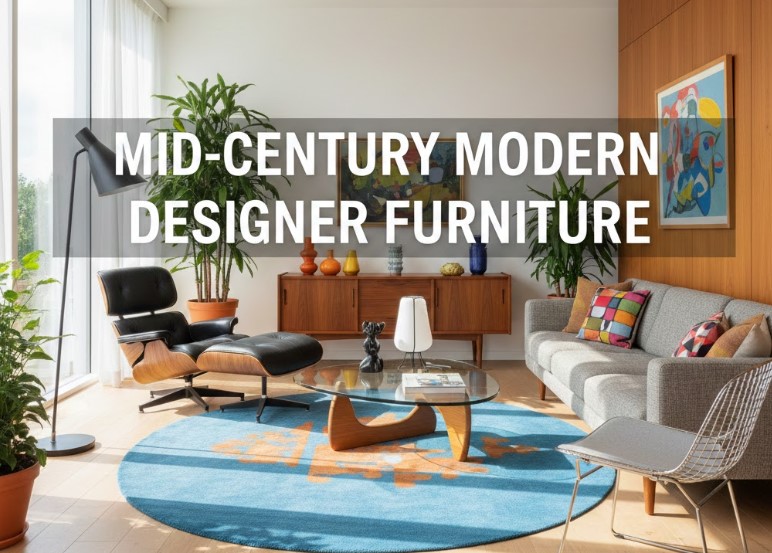
The world of interior design is perpetually shifting, yet one aesthetic consistently holds its ground, capturing the imaginations of designers, collectors, and homeowners alike: Mid-century modern designer furniture.
This style, which roughly spans the period from the mid-1940s through the late 1960s, represents far more than just a passing trend; it is a profound cultural and design movement born from post-war optimism and a new focus on functional, accessible beauty.
The pieces from this era; characterized by clean lines, organic curves, and a harmonious blend of form and function, have transcended mere utility to become veritable icons of modern living.
To understand the pervasive appeal of Mid-century modern designer furniture is to understand a moment in history when design was driven by a powerful desire to improve everyday life, making high-quality, aesthetically pleasing objects available to the burgeoning middle class.
The foundational principle guiding the creation of Mid-century modern designer furniture was a rejection of the ornate, heavy, and often cluttered Victorian and Edwardian aesthetics that preceded it.
Instead, designers embraced simplicity, utility, and natural materials. This shift was fueled by technological advancements during the war, which opened up new possibilities for materials like molded plywood, fiberglass, and various metals, allowing for shapes and forms previously unattainable.
This design philosophy, heavily influenced by the German Bauhaus school, sought to merge architecture, art, and craft into a single, cohesive discipline where an object’s form was dictated by its intended use, the ultimate expression of “form follows function.”
Iti s this marriage of innovative materials and user-centric design that solidified the style’s place in the pantheon of design, ensuring that pieces conceived over half a century ago feel perfectly at home in contemporary interiors today.
The Golden Age of Design Innovation: Key Figures of Mid-century Modern Designer Furniture
The explosion of creativity that defined this era was driven by a cadre of visionary talents, many of whom were either emigrants from Europe seeking new opportunities or American designers who embraced the progressive ideals of modernism.
These individuals didn’t just create chairs and tables; they engineered solutions for living, giving rise to the most celebrated examples of Mid-century modern designer furniture that are instantly recognizable the world over.
1. Charles and Ray Eames: The Architects of Post-War Possibilities
Charles and Ray Eames stand as monumental figures whose influence permeates every aspect of Mid-century modern designer furniture, embodying the very spirit of experimentation and democratic design that defined the era.
Their work was driven by an obsessive commitment to problem-solving, exploring how new materials and manufacturing techniques could be leveraged to create high-quality, beautiful, and most importantly, affordable objects for the masses.
Early in their career, they focused on the groundbreaking manipulation of molded plywood, a material they perfected initially for military applications like splints and stretchers during WWII.
This mastery led to their iconic series of molded plywood chairs, such as the Eames Lounge Chair Wood (LCW), affectionately known for its curvilinear form as the “Potato Chip Chair”.
These chairs demonstrated a radical departure from traditional carpentry, utilizing compound curves that cradled the human body ergonomically, turning a single sheet of wood into a comfortable, sculptural seat.
Beyond plywood, their exploration extended to fiberglass and aluminum, resulting in the versatile and vibrant Eames Molded Plastic Chairs and the globally recognized Eames Lounge Chair and Ottoman, a paragon of luxury and comfort crafted from sumptuous leather, rich veneers, and cast aluminum.
The Eameses were not just furniture designers; they were multidisciplinary pioneers whose philosophy that design should be accessible, functional, and joyful remains the ultimate benchmark for quality Mid-century modern designer furniture.
2. Arne Jacobsen: The Master of Sculptural Minimalism
Arne Jacobsen, a highly accomplished Danish architect and designer, brought a unique architectural rigor and sculptural elegance to the world of Mid-century modern designer furniture, creating pieces that are instantly recognizable for their fluid lines and organic simplicity.
Unlike some American counterparts who embraced technological materials with bold industrialism, Jacobsen filtered the modernist impulse through a distinctly refined Scandinavian lens, prioritizing natural form and meticulous craftsmanship.
His most celebrated works were often integral parts of larger architectural projects, ensuring a holistic design vision. For the SAS Royal Hotel in Copenhagen, he created two of the most enduring icons of the era: the Egg Chair and the Swan Chair.
These pieces were revolutionary in their construction, utilizing a continuous, curved shell of foam and upholstery, offering the user a cocoon-like sense of privacy and comfort within a public space.
Equally important is his ubiquitous Series 7 Chair, which pushed the technology of laminate wood to its limit, resulting in a stackable, lightweight, and incredibly resilient chair that became one of the best-selling chairs in design history.
Jacobsen’s contributions to Mid-century modern designer furniture are defined by his pursuit of a single, perfect form, a truly minimal object where every curve serves both an aesthetic and ergonomic purpose.
3. Hans J. Wegner: The Poet of the Wooden Chair
Hans J. Wegner stands as the undisputed champion of the chair within the Danish Modern movement, earning the moniker “master of the chair” for his prolific and peerless output, having designed over 500 different chairs in his lifetime.
Wegner’s genius lay in his ability to take historical chair forms and strip them down to their absolute essence, revealing the underlying structural logic with elegant simplicity.
His pieces are a testament to the beauty of natural materials, primarily high-quality hardwoods like teak, oak, and beech, and the virtuosity of traditional woodworking techniques, often incorporating complex joinery that is both structural and decorative.
The Wishbone Chair (CH24), perhaps his most recognizable design, beautifully marries traditional Chinese seating with the modernist sensibility, featuring a distinctive split backrest and a hand-woven paper cord seat.
Another pivotal piece is The Chair (JH503), which gained international fame after its use in the 1960 televised debate between John F. Kennedy and Richard Nixon, celebrated for its robust construction and profound sculptural presence.
Wegner’s contribution to Mid-century modern designer furniture is characterized by a deep respect for natural materials, impeccable craftsmanship, and a focus on ergonomic comfort, proving that functional design can also possess the soul of fine art.
4. Eero Saarinen: The Sculptor of Single Forms
Eero Saarinen, a Finnish-American architect and designer, brought a daringly sculptural and often futuristic vision to Mid-century modern designer furniture, driven by a mission to solve perennial design problems with radical, single-form solutions.
Saarinen, much like his friend Charles Eames, was a relentless innovator who sought to simplify the visual language of interiors. His famous quest to eliminate the “slum of legs” commonly found beneath tables and chairs led to his most iconic collection: the Pedestal Series.
This series includes the globally celebrated Tulip Table and Tulip Chair, where the seat or tabletop gracefully emerges from a single, central pedestal base of cast aluminum. This design achieved an unprecedented visual harmony and cleanliness on the floor plane, a breakthrough in furniture architecture.
Beyond the clean lines of the Tulip series, his Womb Chair demonstrated his ability to infuse technical innovation with profound comfort; designed at the specific request of Florence Knoll for “a chair she could really curl up in,” it utilized new foam and fiberglass technology to create a single, enveloping shell.
Saarinen’s pieces are characterized by their smooth, organic geometry, making them timeless examples of Mid-century modern designer furniture that effortlessly blend into any modern space.
5. George Nelson: The Visionary of Modular Living
George Nelson was a pivotal figure in shaping the post-war American design landscape, serving not only as a successful designer but also as the influential Design Director for Herman Miller, where he was responsible for bringing talents like the Eameses and Isamu Noguchi to the company.
Nelson’s philosophy centered on modularity, flexibility, and playfulness, creating pieces of Mid-century modern designer furniture that could adapt to the changing needs of the modern family and office. His own designs often emphasized practical utility with a whimsical flair.
The Platform Bench is a hallmark of his approach; a simple, linear wooden slab supported by thin legs, demonstrating functional simplicity that could serve as seating, a coffee table, or display surface.
The unconventional Marshmallow Sofa is a remarkable example of his ability to integrate bold, graphic elements into upholstery, consisting of eighteen circular cushions attached to a simple metal frame, transforming a traditional sofa into a piece of pop art.
Furthermore, Nelson’s influence extended profoundly into storage solutions, pioneering modular and customizable shelving and cabinet systems that allowed homeowners to tailor their furniture to their specific spatial requirements.
His forward-thinking, pragmatic approach ensured that Mid-century modern designer furniture offered not just style, but intelligent solutions for dynamic modern living environments.
6. Florence Knoll: The Visionary Curator and Corporate Modernist
Florence Schust Knoll (later Florence Knoll Bassett) was not only an accomplished architect and designer but, more importantly, a revolutionary figure who curated the look of post-war American interiors through her role at Knoll Associates.
While many of her own designs, such as the simple, rectilinear Knoll Sofas and Lounge Chairs, were minimalist and rigorously geometric, her greatest contribution was defining the modern corporate environment and assembling a stable of world-class design talent.
She championed the “Knoll Planning Unit,” a methodology that integrated space planning, interior architecture, and furniture selection to create cohesive, modern office spaces, effectively inventing the modern, open-plan corporate aesthetic.
Knoll famously collaborated with her designer friends; including Saarinen, Bertoia, and Mies van der Rohe, to translate their residential concepts into pieces suitable for mass production and commercial use, ensuring that the highest caliber of European modernism was available in the American market.
Her work established a standard of sophisticated elegance and uncompromising functionality, cementing her legacy as the primary force who brought institutional grace to Mid-century modern designer furniture and defined the look of the mid-century executive.
7. Isamu Noguchi: The Sculptor of Biomorphic Form
Isamu Noguchi, an American-Japanese artist and sculptor, brought a deeply poetic and organic sensibility to Mid-century modern designer furniture, viewing his functional pieces as extensions of his three-dimensional art.
His designs are characterized by flowing, biomorphic (life-like) shapes that often appear to defy gravity while maintaining perfect structural balance.
His most famous piece, the Noguchi Coffee Table, perfectly embodies his aesthetic: a heavy, free-form glass top resting delicately on two interlocking, sculpted wooden bases. This table is not merely a surface for objects; it is a piece of low-slung, balanced sculpture that anchors a room.
Noguchi also explored lighting with the same sculptural grace, creating the delicate Akari Light Sculptures, which utilized traditional Japanese washi paper and bamboo ribbing to produce soft, diffused light.
His furniture provided a beautiful counterpoint to the more rigid, straight-lined geometry of many contemporary designers, injecting a soft, fluid humanism into the aesthetic.
Noguchi’s designs remain among the most sought-after examples of Mid-century modern designer furniture for their unique blend of Eastern philosophy, Western modernism, and sculptural artistry.
8. Harry Bertoia: The Master of the Wire Mesh Shell
Harry Bertoia, an Italian-born American artist and designer who also worked alongside the Eameses and Saarinen at Cranbrook Academy of Art, is renowned for his innovative use of industrial materials, particularly metal.
His contribution to Mid-century modern designer furniture is defined by the creation of lightweight, visually transparent seating that seems to occupy space without blocking it.
Bertoia’s iconic Diamond Chair is a masterpiece of material efficiency and structural elegance, constructed from a delicate-looking but incredibly strong welded steel wire mesh.
He famously described these chairs as being “made of air,” and their unique form allows them to blend into any setting, acting almost like industrial sculpture that happens to be functional. His work also includes the related Side Chair and the more lounge-focused Bird Chair, all exploring the tensile strength and visual lightness of the industrial wire mesh.
Bertoia’s designs were a radical departure from traditional upholstered furniture, embracing a stark, beautiful geometry that celebrated the material itself.
These pieces solidified his place as a pioneer who successfully married industrial mass production techniques with a refined, artistic vision, offering highly distinctive examples of Mid-century modern designer furniture.
The Anatomy of Style: Key Characteristics of Mid-century Modern Designer Furniture
The enduring success of Mid-century modern designer furniture is attributable to a consistent set of aesthetic and structural principles that make the pieces instantly recognizable and highly adaptable to various interior styles.
1. Clean Lines and Minimalist Silhouettes
The most defining characteristic is the adherence to clean, straight lines juxtaposed with subtle, organic curves. Unlike the fussy details of earlier eras, Mid-century modern pieces are stripped down to their essential forms.
Sofas, sideboards, and occasional tables often feature straight horizontal planes supported by slender, often tapered legs that raise the piece off the floor, creating a sense of lightness and openness, a key feature of quality Mid-century modern designer furniture.
2. The Use of Tapered and Splayed Legs
The characteristic tapered or splayed leg is a hallmark of the style. These legs, thin at the bottom and slightly wider at the top, sometimes angled outwards, do more than just support the piece; they add a distinct visual energy.
They elevate the furniture, allowing light to flow beneath it, which makes rooms appear larger and less cluttered. This detail is crucial for identifying authentic and high-quality Mid-century modern designer furniture.
3. A Celebration of Materiality
Mid-century modern designers were fearless in their choice of materials, often celebrating the natural texture and grain of their chosen medium.
- Woods: Teak, rosewood, walnut, and oak were favored for their rich color and durability. The grain of the wood was often the only ornamentation required for a sideboard or cabinet.
- Innovations: The era saw the popularization of molded plywood, allowing for comfortable, shell-like seats; fiberglass (especially in the Eames chairs) for its light weight and color versatility; and aluminum and steel for structural elements and bases.
- Upholstery: Fabrics were often simple, textural, and bright, with a preference for wools, tweeds, and high-quality leathers, ensuring the upholstery complemented the simplicity of the wooden or metal frame of the Mid-century modern designer furniture.
4. Integration of Form and Function (Utility and Comfort)
Every piece of Mid-century modern designer furniture was designed with a specific purpose in mind, and that purpose was to facilitate modern living.
Sectional sofas offered flexibility for entertaining, modular storage units could be reconfigured as needs changed, and ergonomic seating, like the molded plastic shell chairs, was designed to cradle the body comfortably. The designs prioritized how people would live with the objects, not just how they would look.
Beyond the Chair: Iconic Categories of Mid-century Modern Designer Furniture
While seating is often the first thing that comes to mind, the scope of Mid-century modern designer furniture encompasses every element of the home, from lighting to storage.
Storage and Case Goods
The sideboard or credenza is one of the most beloved and functional pieces of the era. These low, long cabinets, often featuring a combination of drawers and doors, perfectly embody the style’s aesthetics.
Key features include recessed handles or simple pulls, and again, the classic tapered legs. A well-designed sideboard provides immense storage without dominating a room, acting as a clean, elegant stage for art or lamps.
Similarly, dressers and cabinets from this era follow the same principles: minimal ornamentation, reliance on the beauty of the wood grain, and a focus on modular, scalable storage.
Tables and Desks
The revolution in forms is perhaps most evident in the tables. Dining tables often feature extensions or leaf systems to maximize flexibility for various social gatherings.
The use of glass or marble tops on slender metal bases provided a light, floating appearance, contrasting with the heavier tables of previous generations.
Coffee tables are often asymmetrical or biomorphic (free-form, organic shapes), designed not just as a place to rest a drink but as a piece of low-slung sculpture for the living area. The desks of the era introduced the concept of the “executive desk”.
They are clean, often L-shaped or modular, designed to foster a sense of organization and efficiency in the modern office or study.
The Role of Lighting
Lighting in the mid-century modern aesthetic is inseparable from the furniture. Lamps are often sculptural and playful, acting as a visual counterpoint to the more restrained wooden pieces.
Designs like the Arco Floor Lamp (though slightly later) or the various bubble lamps by George Nelson demonstrate an imaginative use of materials like spun aluminum, brass, or translucent plastic to diffuse light softly while creating an object of arresting visual interest.
This element of design is crucial for anyone curating a space filled with Mid-century modern designer furniture.
Collecting and Integrating Mid-century Modern Designer Furniture Today
The enduring popularity of Mid-century modern designer furniture has led to a robust and diverse market. While original vintage pieces command high prices, the style is also celebrated through thoughtful, high-quality reissues and reproductions.
The Value of Authenticity
For the serious collector, an original piece of Mid-century modern designer furniture is an investment. Key factors determining value include:
- Designer and Manufacturer: Pieces by the leading names (Eames, Wegner, Saarinen, Knoll, Herman Miller) with clear provenance and maker’s marks are the most sought after.
- Condition and Patina: While some restoration is acceptable, collectors often value the original patina, as long as the piece is structurally sound.
- Rarity and Materials: Limited production runs or pieces made with increasingly rare or protected woods (like Brazilian Rosewood) significantly increase the market price.
Blending Vintage and Contemporary
One of the greatest strengths of Mid-century modern designer furniture is its versatility. It blends seamlessly with a wide range of contemporary aesthetics:
- Scandi-Minimalism: The natural woods and clean lines pair perfectly with the bright, airy feel of Scandinavian style.
- Industrial Chic: The metal and raw materials used in many mid-century pieces complement the exposed brick and steel of an industrial loft.
- Bohemian/Eclectic: The simple, sculptural forms provide a grounding structure against which bolder textiles, plants, and travel-inspired accessories can pop.
When integrating these pieces, the key is balance. A single, iconic piece; like an Eames Lounge Chair or a Wegner dining table, can anchor a room.
Mixing vintage finds with new, contemporary sofas or accessories ensures the room feels curated and fresh, not like a museum exhibit. The simple silhouettes of the Mid-century modern designer furniture prevent the space from ever feeling dated or heavy.
The Ethics of Reproduction and Sustainability
The high demand for Mid-century modern designer furniture has also spurred conversations about ethical sourcing and sustainability. Many high-end manufacturers today produce authorized reissues, using the original specifications and modern, sustainably sourced materials.
This allows a new generation to appreciate the design without contributing to the market for unethically sourced vintage wood or poor-quality replicas. The style itself, focused on durable materials and timeless design, aligns perfectly with modern sustainability goals.
The Legacy and Future of Mid-century Modern Designer Furniture
The movement’s influence is so profound that it has fundamentally shaped what we understand as “good design” today. From the ergonomic contours of modern office chairs to the sleek, integrated designs of consumer electronics, the principles pioneered by the masters of Mid-century modern designer furniture are all around us.
The style’s longevity speaks to more than just aesthetics; it speaks to a deep, human need for objects that are beautiful, useful, and honest in their construction.
The pieces created during this golden era are not just relics of the past; they are functional works of art that continue to inspire designers and offer comfort and elegance to the modern home.
They are a permanent reminder that true innovation is not about fleeting trends, but about creating forms that meet human needs with grace and lasting simplicity.
For those looking to furnish a home, or simply to appreciate the highest form of design, exploring the vast and fascinating world of Mid-century modern designer furniture is a journey well worth taking. It is a style that promises not just a beautiful interior, but a connection to an optimistic moment in history when design was truly revolutionary.